

By the Beyond Rugs Design Team — Updated May 2026
Choosing the wrong rug size is one of the most common — and most visible — decorating mistakes a homeowner can make. A rug that's too small looks like a postage stamp in the middle of a room. One that's too large swallows the space whole. Get it right, and the entire room clicks into place.
At Beyond Rugs, we've helped thousands of customers across the US find the right size — from studio apartments in New York to open-plan living rooms in Texas. This guide covers every room, every scenario, and every layout question we've ever been asked.
The short answer: most people buy a rug that's too small. When in doubt, go one size up.
Standard Rug Sizes — What's Available
Before we get into room-by-room rules, here's what the standard sizes actually look like in real life:
|
Size |
Best For |
Typical Use Case |
|
2×3 ft |
Accent / entryway |
Front door mat, small bathroom, under a side table |
|
3×5 ft |
Small accent |
Kitchen, hallway, in front of a sofa (tight spaces) |
|
4×6 ft |
Small room |
Studio bedroom, kids' reading corner, small home office |
|
5×8 ft |
Medium living room |
Apartment living room, guest bedroom, dining area (4-seat table) |
|
6×9 ft |
Medium-large |
Mid-size living room, master bedroom foot-of-bed placement |
|
8×10 ft |
Large living room |
Standard US living room — most popular size overall |
|
9×12 ft |
Open-plan / large room |
Expansive living rooms, dining rooms with large tables |
|
10×14 ft |
Grand spaces |
Great rooms, formal dining, commercial applications |
|
Custom |
Any space, any shape |
Built to your exact dimensions — available from Beyond Rugs |

Living Room Rug Sizes
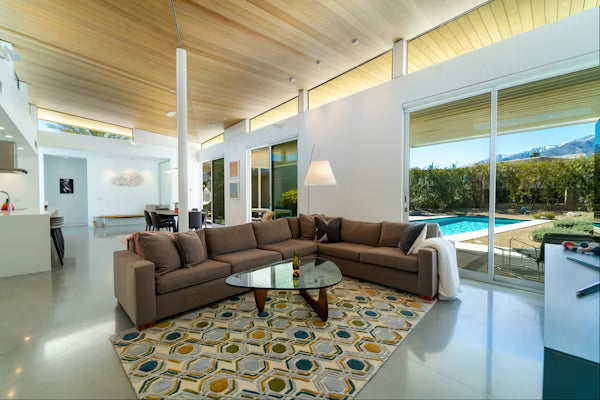
The living room is where rug sizing matters most — and where we see the most mistakes. The core principle is simple: at least the front two legs of your sofa and chairs should sit on the rug. All four legs on the rug is even better for larger spaces.
The Three Placement Approaches
All furniture on the rug: Best for large open-plan rooms. Choose a 9×12 ft or larger. This anchors the entire seating group and makes the room feel cohesive.
Front legs on the rug: The most common and versatile approach. Works in most living rooms with an 8×10 ft or 9×12 ft rug. Pulls furniture into the space without requiring a massive rug.
Rug as a floating island: For smaller spaces or a deliberate minimalist aesthetic. A 5×8 ft rug sits in front of the sofa with no furniture legs on it. Works best when the sofa is pushed against the wall.
|
Living Room Rule of Thumb: Measure the seating area (not the whole room), then choose a rug that's 12–18 inches narrower than that measurement on each side. An 8×10 ft rug works for most standard US living rooms; go 9×12 ft if you have a sectional. |
|
Room Width |
Recommended Rug Size |
|
Up to 10 ft |
5×8 ft |
|
10–12 ft |
8×10 ft |
|
12–15 ft |
9×12 ft |
|
15 ft+ |
10×14 ft or custom |
Bedroom Rug Sizes
Bedroom rug placement depends almost entirely on bed size. The goal is to have soft rug underfoot when you step out of bed each morning — there's nothing worse than planting your feet on cold hardwood at 6am.
By Bed Size
Twin / Full: A 5×8 ft rug placed under the lower two-thirds of the bed works well. Alternatively, two small 2×3 ft rugs on either side of the bed.
Queen: An 8×10 ft rug extending 18–24 inches on either side and at the foot of the bed. This is the most popular bedroom rug size in the US.
King: A 9×12 ft rug is ideal — it extends generously on all three exposed sides. A 10×14 ft is a luxurious choice for large master bedrooms.
|
Pro tip: If you have hardwood floors and a smaller budget, use a smaller rug just at the foot of the bed (3×5 ft or 4×6 ft) combined with bedside runners on each side. This costs less and still delivers the underfoot warmth that matters. |

Dining Room Rug Sizes
Dining room rugs have one non-negotiable rule: the rug must be large enough that chairs remain on the rug even when pulled out from the table. A chair leg dropping off the edge of the rug every time someone sits down is deeply annoying — and it damages both the rug edge and the floor.
The standard calculation: measure your table, then add 24 inches (60 cm) on every side. That accounts for a chair pulled out with a seated person.
|
Dining Table Size |
Minimum Rug Size |
Ideal Rug Size |
|
36×48 in (4-seater) |
6×9 ft |
8×10 ft |
|
36×60 in (6-seater) |
8×10 ft |
9×12 ft |
|
36×72 in (6–8 seater) |
9×12 ft |
9×12 ft or custom |
|
Round table (48 in dia) |
6×6 ft round or 8 ft round |
8 ft round or 9×9 ft |
|
Round table (60 in dia) |
8 ft round |
9 ft round or custom |

Home Office Rug Sizes
For home offices, the rug should accommodate the desk chair rolling back without catching on the edge. A 5×8 ft rug works for most standing desk setups. If you have an L-shaped desk, a 6×9 ft or 8×10 ft ensures the chair rolls freely.
One often-overlooked consideration: hard flooring under a rug causes desk chairs to roll unpredictably. A low-pile flatweave rug — like our Belin flatweave collection — works far better under rolling chairs than a plush hand-tufted pile.
Kids' Room Rug Sizes
Kids' room rugs should prioritize floor coverage. Children play on the floor — the more rug the better. An 8×10 ft in a standard children's bedroom covers the central play area and most of the walking paths. A round rug (6–8 ft diameter) works beautifully under a play table or reading nook.
Our kids' room rug collection includes durable, easy-clean options sized appropriately for smaller spaces.
Hallway & Runner Sizes
Runners are defined as any rug that's at least twice as long as it is wide. Standard runner widths are 2–3 ft; lengths range from 6 ft to 14 ft. Leave 4–6 inches of bare floor on each side of the runner for visual balance.
For staircase runners, measure the total staircase length (number of stairs × average rise + tread). Add 10% for tucking and trimming.
What If No Standard Size Fits?
This is more common than you'd think — especially in open-plan homes, unusual room shapes, or spaces with built-in furniture. Beyond Rugs offers a full custom rug service: choose your exact dimensions, shape, material, and design. There are no minimum order sizes for custom rugs.

FAQ: Rug Sizes
|
Q: What is the most popular rug size in the US? |
|
A: 8×10 ft is the most popular rug size in American homes. It fits the majority of standard living rooms with front-leg furniture placement and works in master bedrooms under queen and king beds. |
|
Q: Can a rug be too big for a room? |
|
A: Yes — a rug should leave at least 12–18 inches of bare floor between its edge and the walls. If a rug leaves less than 12 inches of floor showing, it overwhelms the space and makes the room look smaller. |
|
Q: Is it better to have a rug too big or too small? |
|
A: Too big is almost always better than too small. A slightly oversized rug grounds the room; a too-small rug looks like an afterthought and can make furniture arrangements feel disjointed. |
|
Q: How do I measure my room for a rug? |
|
A: Measure the length and width of your seating area (not the entire room). For living rooms, measure from the sofa to the opposite furniture. Choose a rug 12–18 inches smaller than that measurement on all sides. |
|
Q: Should a rug go under a sofa? |
|
A: For the 'front legs on' method — the most popular approach — only the front two legs of the sofa sit on the rug. For full-room layouts, all furniture sits on the rug. For floating island placement, no furniture is on the rug. |
|
Q: What size rug do I need for a 6-seater dining table? |
|
A: A 6-seater dining table typically measures 36×72 inches. You need a minimum 9×12 ft rug to allow chairs to remain on the rug when pulled out. Measure your specific table and add 24 inches on each side to confirm. |
|
Q: Do I need a custom rug if my space is an unusual shape? |
|
A: Not always — irregular rooms often work with a standard rectangular rug positioned in the main seating area. But for alcoves, L-shaped rooms, or spaces with unusual proportions, a custom rug is the cleanest solution. Beyond Rugs offers custom sizing with no minimum order. |
|
Q: Is a 5×8 ft rug too small for a living room? |
|
A: For most standard US living rooms (12 ft or wider), yes — a 5×8 ft rug will feel undersized. It works well in smaller apartments, studio spaces, or as a secondary rug layered over a larger jute base rug. |
Need a custom size? Build your own rug →


Leave a comment
This site is protected by hCaptcha and the hCaptcha Privacy Policy and Terms of Service apply.