

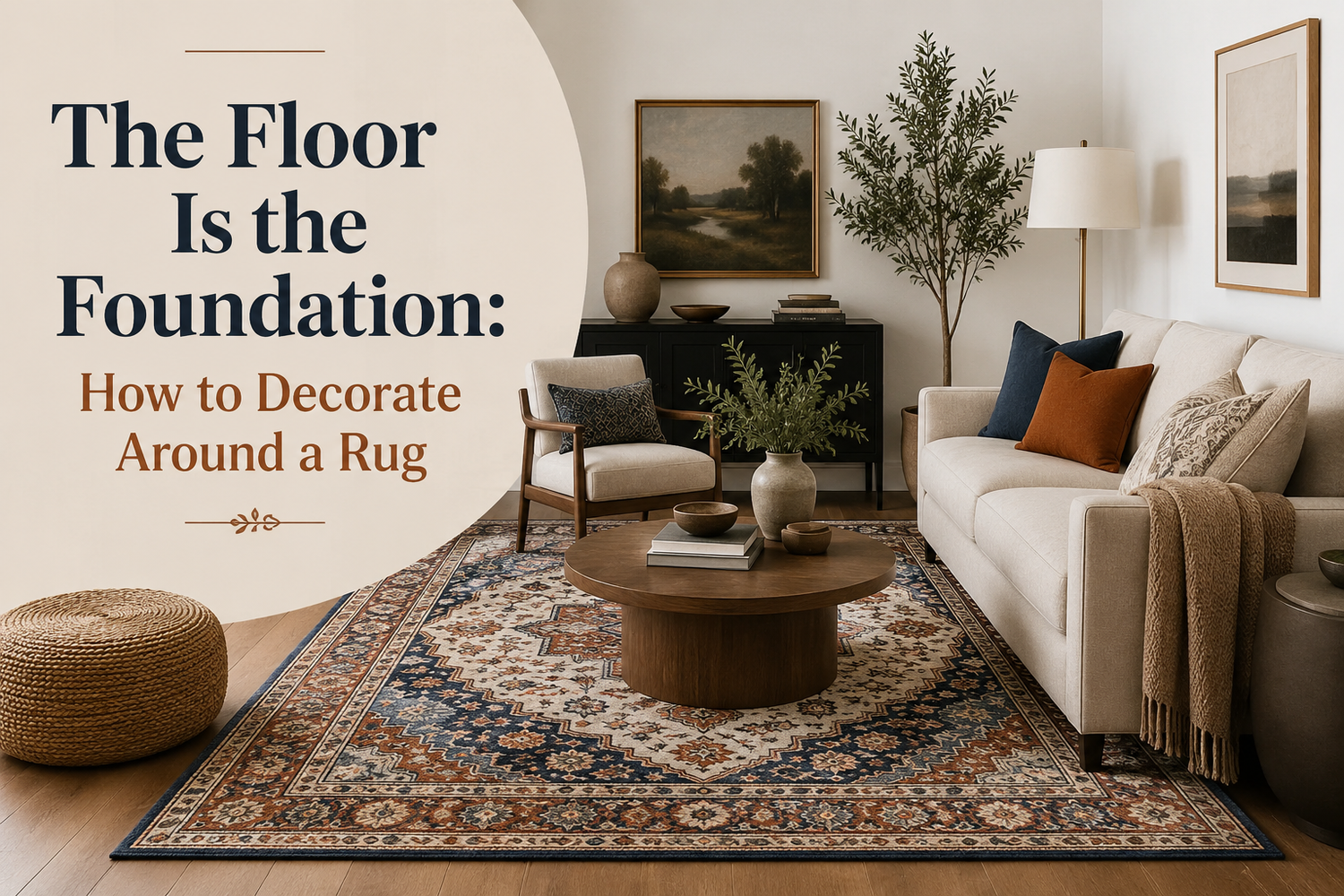
There's a specific type of living room that most people have at some point in their lives: a sofa in a colour they chose carefully, a coffee table that took three weeks to arrive, side tables that coordinate with the shelving, curtains they're fairly happy with — and a rug that none of it quite works with.
The rug was bought last. It was bought from what was left over in the budget and from whatever was available in the right size. It's not offensive. It just doesn't belong in the way everything else does.
Interior designers almost never make this mistake, and the reason is straightforward: they don't choose the rug last. Knowing how to decorate around a rug — or better, how to build a room outward from one — is the single biggest shift in thinking that separates a designed room from an assembled one.

Why the Sequence Matters
The floor is the largest continuous surface in most rooms. It's the thing every other object in the room sits on or above. The colour, texture, and visual weight of the floor — which in a rugged room means the rug — sets the register for everything else.
When you choose the sofa first, you've committed a colour to the most dominant upholstered surface in the room. When you choose the rug after that, you're trying to find something that works with a decision that was already made. Your options narrow with every decision that precedes the rug.
When you choose the rug first, the opposite happens. You start with the foundational element and build outward. The sofa colour becomes a response to the rug. The curtains coordinate with the rug's undertones. The coffee table's material echoes or deliberately contrasts with the rug's texture. Every subsequent decision has something to respond to.
This is not a small difference in how a room ends up looking.
Reading a Rug Before You Buy It
To start with a rug, you need to be able to look at one and understand what it's asking for — which colours it wants around it, which furniture it needs to anchor, which rooms it will claim and which it will fight.
Identify the undertone, not just the colour
A beige rug and a cream rug are not interchangeable. Beige reads warm — it wants wood tones, terracotta accents, amber lighting. Cream reads cool — it wants linen, white oak, softer light. When a room feels 'off' but everything seems coordinated, mismatched undertones are usually why.
Look at the rug under natural light, not the store lighting or the product photograph. Natural light is the only honest interpreter of colour. If you're buying online, request a sample if possible, or read the return policy — you need to see it in your room before committing.
Understand its visual weight
A dark, dense rug with a complex pattern has high visual weight — it claims the room and demands that surrounding furniture recede to let it breathe. A light, open rug with a subtle texture has low visual weight — it supports rather than anchors, and can take bolder furniture without competition.
Neither is better. Both require you to know which you have before you start adding furniture.
Consider the pile's effect on atmosphere
A high-pile wool rug makes a room feel cushioned and private — it absorbs sound, creates warmth, signals comfort. A flatweave jute rug does the opposite: it keeps the room airy, slightly formal, appropriate to rooms where you want to feel alert rather than settled.
Which atmosphere do you want in this room? That question is worth answering before you choose the rug, not after.

How to Actually Build a Room Around a Rug
Let's make this concrete. Say you've found a rug you respond to — a hand-tufted wool piece in a warm, slightly dusty terracotta with a loose abstract pattern in muted olive. Here's how to build outward from it:
Step 1: Identify the dominant and secondary colours in the rug. In this case: terracotta ground (dominant), muted olive pattern (secondary). These two colours are now your room's palette. Everything else either coordinates with them, responds to them, or deliberately contrasts with them.
Step 2: Choose a sofa colour that responds to the dominant — not matches it. A warm greige linen sofa will let the terracotta lead. A dusty pink sofa would compete with it. A dark charcoal sofa would create contrast that might work, but requires confidence to pull off. The safest principle: the sofa should be quieter than the rug, not louder.
Step 3: Use the secondary colour for accents only — never for dominant surfaces. The olive from this rug should appear in the room 3–5 times in small doses: a throw pillow, a glazed ceramic vase, the cover of a book on the coffee table, a plant pot. Never as a full chair or curtain. Secondary colours that go too large overwhelm the rug's palette rather than completing it.
Step 4: Choose a wood tone that coordinates with the rug's warmth. The terracotta rug wants warm wood — walnut, aged oak, natural teak. It will fight cool grey undertones in ash or bleached maple. When in doubt, bring a photo of the rug to the furniture store. Colour relationships that seem obvious in your head are harder to hold in memory when you're standing in front of a showroom floor.
Step 5: Add texture that contrasts with the pile. If the rug is high-pile and plush, add something smooth nearby — a leather ottoman, a lacquered side table, a linen cushion cover. If the rug is a flatweave, add texture elsewhere — a bouclé throw, a rattan pendant light, a rough-glazed ceramic. Contrast in texture keeps a room visually active without requiring contrast in colour.

The Case for Irregular Shaped Rugs in This Approach
One of the most liberating things about starting with the floor is that it opens up the rug shapes you can consider. When the rug is an afterthought, you pick a rectangle that fits under the existing furniture. When the rug is the foundation, you can ask a different question: what shape does this room actually want?
Sometimes the answer is still a rectangle. But in rooms with curved sectionals, in spaces that flow between two zones, in rooms where every other surface is already angular and the space feels rigid — the answer is often not.
An amoeba-shaped rug centred under a seating group doesn't fight the furniture. It grounds it differently — softly, with movement rather than perimeter. The organic boundary of the rug creates a counterpoint to the straight lines of the sofa without competing with them. A melting-edge rug in a home office becomes the single element that makes an otherwise utilitarian room feel considered. A splash-form rug in a dining room turns the floor into a genuine design moment rather than just a surface.
These design decisions are only available to you if the rug comes first. If you're trying to fit an irregular rug under a furniture arrangement that was never designed for it, you'll almost always be disappointed. Start with the shape, then arrange around it.
Browse our irregular shaped rug collection →
What to Do If You've Already Got the Furniture
Most people reading this have furniture. The sequence advice is useful for future rooms or renovations; for the room you're in right now, here's the practical version:
Work backwards through the steps above. Look at your dominant surfaces — sofa, curtains, largest piece of wood furniture — and identify their undertones. Find a rug that responds to those undertones rather than duplicates them. Go large rather than small; the most common issue in already-furnished rooms is choosing a rug that gets dwarfed by what's around it.
And remember: a rug is far easier to swap than a sofa. If you're not happy with it after a few weeks, return it and try again. The right rug for your room exists. The search is part of the process.

Frequently Asked Questions
Q: Should I choose my rug before or after my sofa?
Before, ideally. The rug is the foundational floor element — it's easier to choose a sofa that responds to a rug than to find a rug that works with a sofa you've already committed to. If you're starting a room from scratch, choose the rug first, then build the furniture palette around it.
Q: How do I know what colour rug to choose for my room?
Identify the undertones of your dominant existing elements first (floor, sofa, walls if they're a strong colour). Then choose a rug that shares an undertone — not a matching colour, a matching undertone. A warm grey sofa wants a rug with warm undertones; a cool grey sofa wants a rug with cool ones. Getting the undertone right matters more than getting the exact colour right.
Q: Can I use a patterned rug if my sofa is already patterned?
Yes, but you need to manage the scale contrast carefully. If your sofa has a small, tight pattern (a small check, a fine texture), a rug with a large, open pattern creates good contrast. If your sofa has a large pattern, choose a rug with a subtle, low-contrast design or a solid that picks up one of the sofa's colours.
Q: What shape rug works best in a living room?
A rectangle works for most living rooms with standard furniture arrangements. A round rug works well under a round coffee table or in a room where you want to soften a very angular space. An irregular shaped rug works best when you're building the room with the rug as the centrepiece — it needs space around it to read properly and furniture that doesn't fight its boundary.
Q: How far should a rug extend past the sofa?
The front legs of the sofa should sit on the rug, with the rug extending 12–18 inches beyond the sofa on the sides and front. If you can fit all four legs of the sofa on the rug, that's even better — it anchors the furniture group more decisively. The rug should never end in the middle of the open space between the sofa and a chair — it needs to either include the chair or leave a clear floor gap between them.
There's a version of interior decorating that's about managing uncertainty — buying things that won't look wrong. And then there's the version that's about making specific choices that make a room feel like it was put together by someone with a point of view.
The rug is where that choice usually starts. Start there. The rest gets easier.
Related reading:
- Irregular & Shaped Rugs: The 2026 Trend Guide →
- The Complete Rug Size Guide: Exactly What Size Rug Do You Need? →
- Wool vs Jute vs Cotton Rugs — Which Material Is Right for Your Home? →



Leave a comment
This site is protected by hCaptcha and the hCaptcha Privacy Policy and Terms of Service apply.