

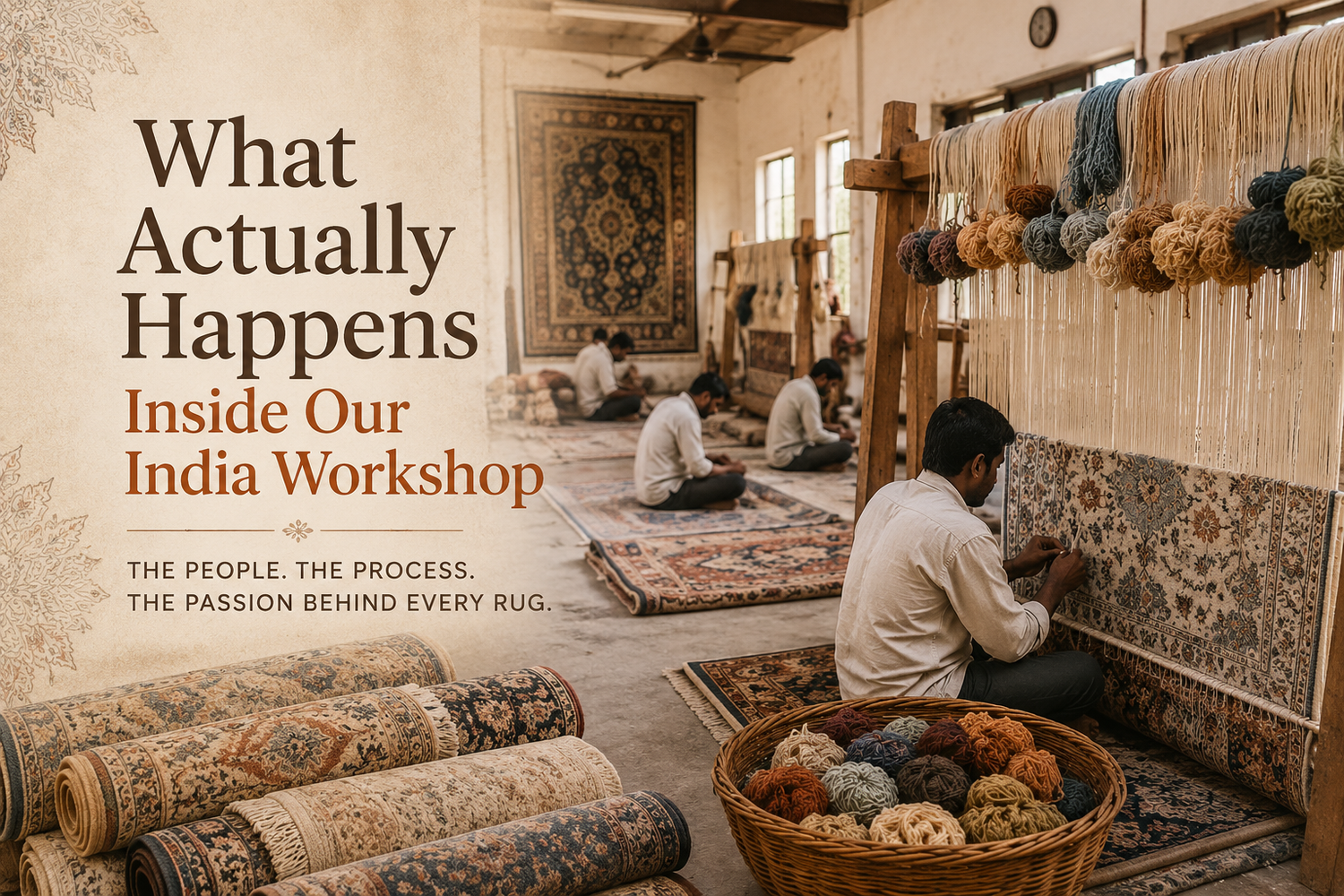
'Handmade in India' appears on a lot of rug listings. It appears on ours. It's also a phrase that can mean almost anything — from 'a human being pressed a button on a machine at some point in the process' to 'a skilled artisan spent two weeks on this specific piece.' The difference is significant, and you deserve to know which category you're buying from.
So here's what actually happens when we make a rug.
It Starts with the Canvas
The foundation of every handmade rug in India using the hand-tufting method is a canvas — a coarse fabric stretched tightly over a wooden frame, roughly the size of the finished rug. Think of it like a painter's canvas, but the size of a floor.
The pattern for the rug is drawn directly onto this canvas. By hand. Either freehand by an experienced artisan who has done this long enough that the proportions live in his hands, or transferred from a paper template for more complex geometric or repeating designs.
This drawing step matters more than it looks. The artisan who draws the pattern is making decisions about how the design will read at scale — where to increase line weight so a motif doesn't disappear at 8 feet, how to handle curves so they look intentional rather than wobbly, which areas need more definition when the pile is adding three millimetres of depth. A pattern that works as a small drawing doesn't automatically work at 8×10 feet. Someone has to translate between those scales, and that requires judgment that comes from years of doing it.

The Tufting Process
A tufting gun is a handheld tool that looks like something between a power drill and a heavy-duty staple gun. It works by pushing a loop of yarn through the canvas backing at speed, leaving a tuft behind as the artisan moves the gun forward. Row by row, section by section, the pile builds up on the front face of the canvas.
This sounds mechanical. It isn't, quite.
The artisan's hands control the speed, the direction, the pressure. Moving too fast leaves gaps in the pile; too slowly creates uneven density that shows up as texture variation under raking light. Around curves and in corners, the path has to be continuously adjusted — the gun doesn't understand arcs, the person holding it does. And for every colour change in the pattern, the yarn spool has to be switched and the new colour started precisely at the boundary of the previous one.
An experienced tufter can read a canvas the way an experienced driver reads a road — anticipating what's coming, adjusting before the problem occurs. A newer tufter follows more carefully, checks more often. The difference shows up in the finished pile. Not dramatically, but it's there if you know where to look.
The Step Most People Don't Know About: Carving
Once the tufting is complete, the pile is trimmed to a consistent height — but before that, it's carved.
Carving is what separates the surface of a thoughtfully made rug from a flat, uniform pile that happens to have a pattern in it. An artisan uses a pair of curved scissors or a small electric trimmer to sculpt along pattern edges — deepening the distinction between two adjacent colours, creating a slightly raised field in a central motif, adding the subtle low-relief shadowing that makes a geometric pattern read three-dimensionally when light falls across it at an angle.
This is the closest thing in hand-tufted rug making to what a sculptor does when they move from a rough form to a finished surface. The basic shape is already there from tufting; the carving reveals it.
Most people never notice the carving consciously. They just notice that the rug looks right — that the pattern has presence, that the colours have separation, that there's something going on with the surface that a photograph doesn't quite capture. The carving is why.
Backing, Sealing, Washing
The back of the tufted canvas receives a layer of latex adhesive, applied by hand across the entire surface. This is what locks every tuft in place. It's why a well-made hand-tufted rug stops shedding after the first few months — once the loose fibres from the tufting process have vacuumed out, the rest are held permanently.
A second fabric layer, called a scrim backing, is pressed into the wet latex to provide structural support and protect the adhesive from floor friction over time. Then the whole thing is left to cure.
Then the rug is washed. Not spot-cleaned — fully washed, in water, which relaxes the fibres that have been compressed by tufting and sets the pile at its final texture. After washing it's stretched on frames to dry flat, which ensures the rug holds its intended dimensions. A rug dried without stretching can warp slightly at the edges or lose dimensional accuracy. A stretched, dried rug lies flat on the floor the moment you unroll it.

Edge Binding — Where Most Rugs Fail
The final stage is binding — a fabric tape sewn or glued around the entire perimeter of the rug to finish the edge and prevent the pile from unravelling over time.
On a standard rectangular rug, this is straightforward work. On an irregular shaped rug — our Amoeba, Melting Edge, and Splash collections — the binding has to follow a curved, asymmetric edge by hand, which takes considerably more skill and time. The binding artisan has to maintain consistent tension around the curves, overlap correctly at any concave sections, and ensure the tape lies flat rather than bunching on the outer curves.
The binding is the part of a rug most likely to fail over time if it's done poorly. A binding that's glued rather than sewn will separate. A binding applied with inconsistent tension will pucker. We check ours before shipping — not as a formality, but as a specific inspection with the binding as the focus.
Quality Control — What We Actually Reject
Every rug that leaves our workshop has been through a final inspection. This is a specific, unhurried process that covers:
- Pile density and consistency — any areas where the tufting is thinner or thicker than the surrounding pile
- Colour accuracy — checked against the reference design under standard lighting conditions
- Binding integrity — the full perimeter, inspected for adhesion and tension
- Dimensional accuracy — the rug is measured to confirm it matches the listed dimensions within tolerance
- Lay flat test — the rug is laid on a flat surface and any curling, warping, or edge lift is noted
Rugs do get rejected. A colour that drifted off-spec in the dye batch. An edge section where the binding hasn't adhered correctly. A small area of pile that didn't set properly in the wash. Those pieces don't ship. They go back through correction if the issue is fixable, or they're written off if it isn't.
This adds time and cost. We think it's the process.
What This Means for the Rug You Receive
It means that what arrives at your door is not identical to the previous version of the same design, or the next one. The dye batch will be very close, but close. The pile height will be consistent, but not laser-measured. The pattern will match the reference design — but an artisan drew it and tufted it and carved it, so it will carry the small evidence of those hands.
Some customers find this deeply reassuring. A few find it slightly unsettling — they want exact. If exact is what you need, machine-made rugs will serve you better, and there's no judgment in that. But if what you want is an object that was made by a person who was paying attention — this is how those get made.

Frequently Asked Questions
Q: How long does it take to make a hand-tufted rug?
A standard 5×8 ft rug takes approximately 3–5 working days from canvas drawing to finished, dried, and inspected piece. A larger 9×12 ft takes 7–10 days. Irregular shaped rugs take slightly longer due to the edge binding complexity. These times don't include shipping.
Q: Why do new hand-tufted rugs shed?
Shedding in the first weeks is normal — it's loose fibres from the tufting process that weren't fully anchored by the latex backing. These work their way out naturally with regular vacuuming over the first 3–6 months. It stops on its own. It's not a defect — it's a characteristic of the construction method.
Q: Is hand-tufted the same as handmade?
Yes, hand-tufted rugs are genuinely handmade — a skilled artisan guides the tufting gun and does all the pattern work and carving by hand. However, 'handmade' can also refer to hand-knotted and hand-woven rugs, which are different construction methods. Hand-tufted is a specific technique within the handmade category, not a lesser version of it.
Q: What's the difference between hand-tufted and hand-knotted?
Hand-knotted rugs are made by tying individual knots around warp threads on a loom — a 9×12 ft rug can have millions of individual knots and take 6–18 months to complete. Hand-tufted rugs use a tufting gun and take days to weeks. Hand-knotted rugs are more durable long-term and more expensive. Hand-tufted rugs offer better value, softer feel, and are available in more contemporary designs. See our full comparison →
Q: Can I visit your workshop in India?
We don't currently offer general public visits, but if you're a trade buyer, interior designer, or retailer interested in understanding our production process, contact us through our trade enquiry page and we'll see what we can arrange.
Most people who buy a handmade rug never think about what went into making it. That's probably fine — the rug's job is to be on the floor, not to be admired for its production history. But we think knowing makes you a better buyer. It helps you recognise quality when you see it, and it helps you understand what you're paying for when the price difference between a handmade rug and a machine-made one seems hard to justify.
Now you know what went into it. The rest is just the floor.
Related reading:
- The Rug That Ruined Every Other Rug — Why Handmade Matters →
- Hand-Tufted vs Hand-Knotted vs Flatweave — What's the Actual Difference?
- Irregular & Shaped Rugs: The 2026 Trend Guide →


Leave a comment
This site is protected by hCaptcha and the hCaptcha Privacy Policy and Terms of Service apply.