

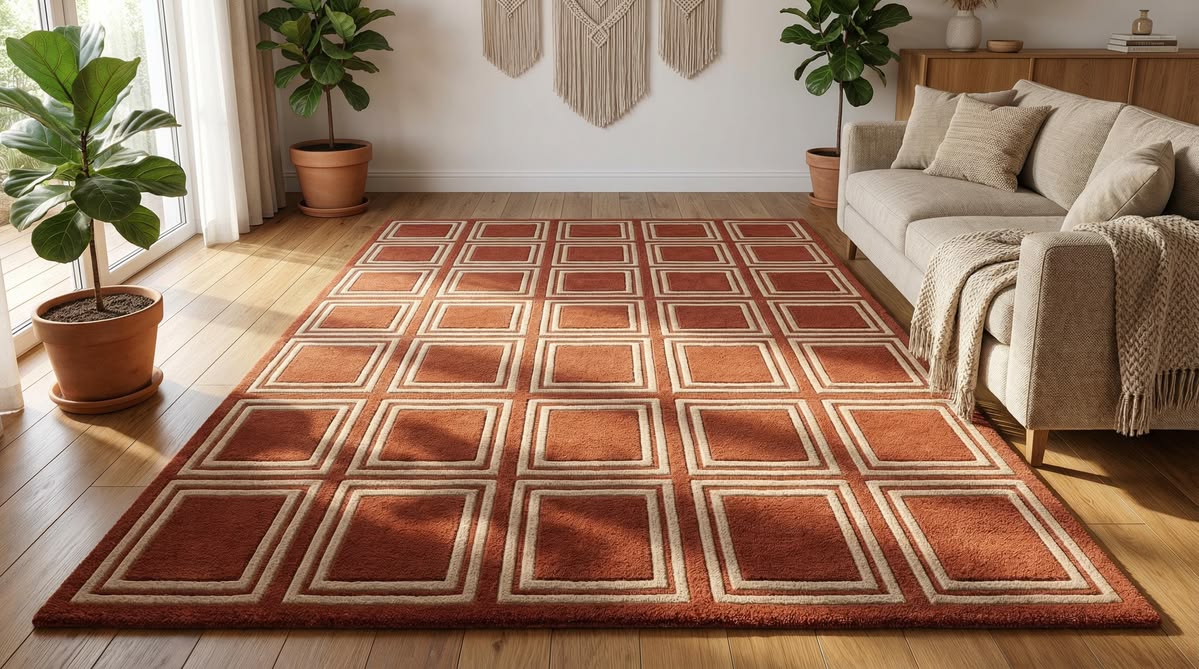
Online rug shopping has a specific failure mode that in-store shopping doesn't: you make your decision from a photograph, and photographs are, at best, a partial truth.
The colour you see on a monitor depends on your monitor's calibration, the photographer's lighting choices, and how aggressively the image was post-processed. The pile height isn't visible. The weight isn't communicable. The way it sits on a floor — whether it lies flat, whether it curls at the corners, whether it moves when you walk on it — none of that is in the listing.
We sell rugs online. We know this problem from both sides of it. Here are the six mistakes we see most often, and what we'd say to someone making each one.

Mistake 1: Measuring the Room Instead of the Furniture
The room dimensions don't tell you what rug size you need. The furniture arrangement does.
The question isn't "how big is my living room?" It's "where does my seating group end?" Measure the outer edges of your sofa and chairs — that rectangle is your reference point. The rug should extend 12–18 inches beyond that grouping on all sides. Not to the walls.
The reason so many people buying a rug online get this wrong: they measure the room, do some rough mental division, and arrive at a number that sounds reasonable. It usually isn't. The 8×10 ft rug that seemed generous on paper looks like a bathmat once the sofa is on it.
The rule for each room:
- Living room: measure the seating group, add 12–18 inches on all sides. An 8×10 ft works for most standard US living rooms.
- Dining room: measure the table, add 24 inches on all sides (enough for chairs to remain on the rug when pulled out). A 6-seat table needs a minimum 9×12 ft rug.
- Bedroom: the rug should extend 18–24 inches on each exposed side of the bed. A queen bed needs at least an 8×10 ft.
Measure the furniture. When in doubt, go one size larger. We've never once had a customer return a rug because it was slightly too big.
Mistake 2: Trusting the Colour in the Product Photo
This one isn't anyone's fault exactly. Digital cameras render colour differently from human eyes. Monitors display colour differently from each other. Product photographers use lighting setups designed to make rugs look appealing — which doesn't always mean accurate.
What actually helps:
Read the colour description carefully. 'Sage green' is doing a lot of work as a description — it could mean muted grey-green, warm yellow-green, or blue-green depending on who named it. Look at lifestyle photography if there is any — images of the rug in a real room, under ambient light, are more accurate than the pure product shot.
And use the return window. Every rug we sell ships free and comes with a 30-day return policy for exactly this reason. Try it in your room, in your light, against your floor. If the colour is wrong, send it back. That's what the policy is for.

Mistake 3: Ignoring Pile Height
Pile height is one of the most consequential specifications when buying a rug online and one of the least read. It determines how the rug feels underfoot, how it photographs, how it wears over time, and whether it works under furniture.
Low pile — under 0.5 inches
Flat, durable, easy to clean. Works under rolling chairs and dining tables. Shows foot traffic patterns less. Not as soft underfoot. Good choice for kitchens, hallways, home offices, and dining rooms.
Medium pile — 0.5 to 1 inch
The sweet spot for most living room and bedroom applications. Soft enough to be comfortable, stable enough to hold furniture without permanent indentation. Where most of our hand-tufted collection sits.
High pile — over 1 inch
Luxurious underfoot, beautiful in low-traffic spaces. Impractical for dining rooms or anywhere you're moving furniture regularly. Collects debris more readily. Needs more careful vacuuming.
The product listing will specify pile height. Read it before you order, not after.
Mistake 4: Choosing Based on Price Rather Than Cost Per Year
A $200 machine-made rug and a $450 hand-tufted wool rug are not in competition if you're thinking clearly about the decision.
The machine-made rug will look tired within 2–3 years of regular use. The pile flattens. The colours go flat. You'll replace it. Total cost over ten years: $600–$1,000 depending on how many replacements.
The hand-tufted wool rug, with basic care, will look better in year five than it did in year one. Total cost over ten years: $450.
Cost per year comparison:
|
Rug type |
Price |
Lifespan |
Cost/year |
|
Machine-made |
$200 |
3 years |
$66 |
|
Hand-tufted wool |
$450 |
20 years |
$22.50 |
|
Hand-knotted wool |
$900 |
40+ years |
$22.50 |
I'm not saying spend more than you can afford. I am saying that the cheapest option over any meaningful time horizon is usually not the lowest upfront price.
A note on 'affordable handmade': It exists. Our price points reflect direct relationships with artisan workshops in India — no intermediary markups, no retail overhead. A genuinely hand-tufted wool rug doesn't have to cost four figures.
Mistake 5: Not Accounting for a Rug Pad
A rug without a pad underneath is a different object from the same rug with a good pad under it.
The pad does three things: it stops the rug moving on hard floors (which causes edge wear and is a tripping hazard), it cushions the pile from compression underfoot, and it extends the rug's usable life by reducing friction between the backing and the floor.
Pad type by floor surface:
- Hardwood or tile: felt-and-rubber pad. The felt side faces up toward the rug; the rubber grips the floor
- Low-pile carpet: rubber mesh or waffle-pattern pad. Prevents the rug shifting on top of the carpet.
- Marble (common in older homes): breathable open-grid rubber. Marble conducts cold and can cause condensation underneath sealed pads — you want air to move.
We don't sell rug pads, which means this advice costs us nothing to give you. Buy a pad.
Mistake 6: Ordering One Rug When the Space Needs Two
Open-plan living spaces — kitchen flowing into living room, dining area adjacent to lounge — are almost never well-served by a single rug. One rug centred in the space usually looks orphaned: too small to anchor the full room, too large to claim just one zone.
Two rugs, each claiming a specific zone, define the space far more effectively. A large rectangular rug under the seating group. A smaller, possibly shaped or circular rug under the dining table. Two distinct objects that happen to be rugs, each with a clear purpose.
The budget instinct is to buy one big rug. The design result is usually better with two considered ones — and the total cost is often similar once you realise you'd have needed to upsize the single rug to make it work anyway.
one rug in large room

Frequently Asked Questions
Q: What is the most common rug-buying mistake?
Buying too small. It's by far the most frequent issue we hear from customers after delivery. The fix is simple: measure the furniture group, not the room, and size up if you're on the border between two sizes.
Q: How do I know if a rug is genuinely handmade when buying online?
Look for the construction method specified in the listing — hand-tufted, hand-knotted, or flatweave are all genuine handmade methods. 'Handcrafted' or 'artisan-made' without a construction method specified is often vague. Read the material description: genuine handmade rugs are almost always wool, cotton, jute, or silk — not 'premium fibres' or 'soft yarns.'
Q: Is it worth paying more for a wool rug?
Yes, if you're buying it for a room you use daily. Wool's natural resilience means the pile doesn't flatten the way synthetic or cotton pile does. It's also naturally antimicrobial and stain-resistant to a degree. The higher upfront cost pays itself back over a lifespan that's 4–6x longer than a typical machine-made alternative.
Q: What should I do if the rug I ordered looks wrong in my room?
Use the return window. Don't convince yourself it'll grow on you — if the colour or size is wrong in the first week, it'll still be wrong in year two. Every rug we sell comes with a 30-day free return. The purpose of that policy is exactly this situation.
One more thing: buy a rug you actually like, not one you think you should like. The 'safe' neutral that goes with everything tends to make a room feel like it was designed by committee. The rug that you were slightly nervous about, the one with the colour or the shape that felt like a decision — that's usually the one that makes the room.
You're going to look at this thing every day for years. Make it worth looking at.
Related reading:
- The Complete Rug Size Guide: Exactly What Size Rug Do You Need? →
- Hand-Tufted vs Hand-Knotted vs Flatweave — What's the Actual Difference? →
- Wool vs Jute vs Cotton Rugs — Which Material Is Right for Your Home? →



Leave a comment
This site is protected by hCaptcha and the hCaptcha Privacy Policy and Terms of Service apply.