

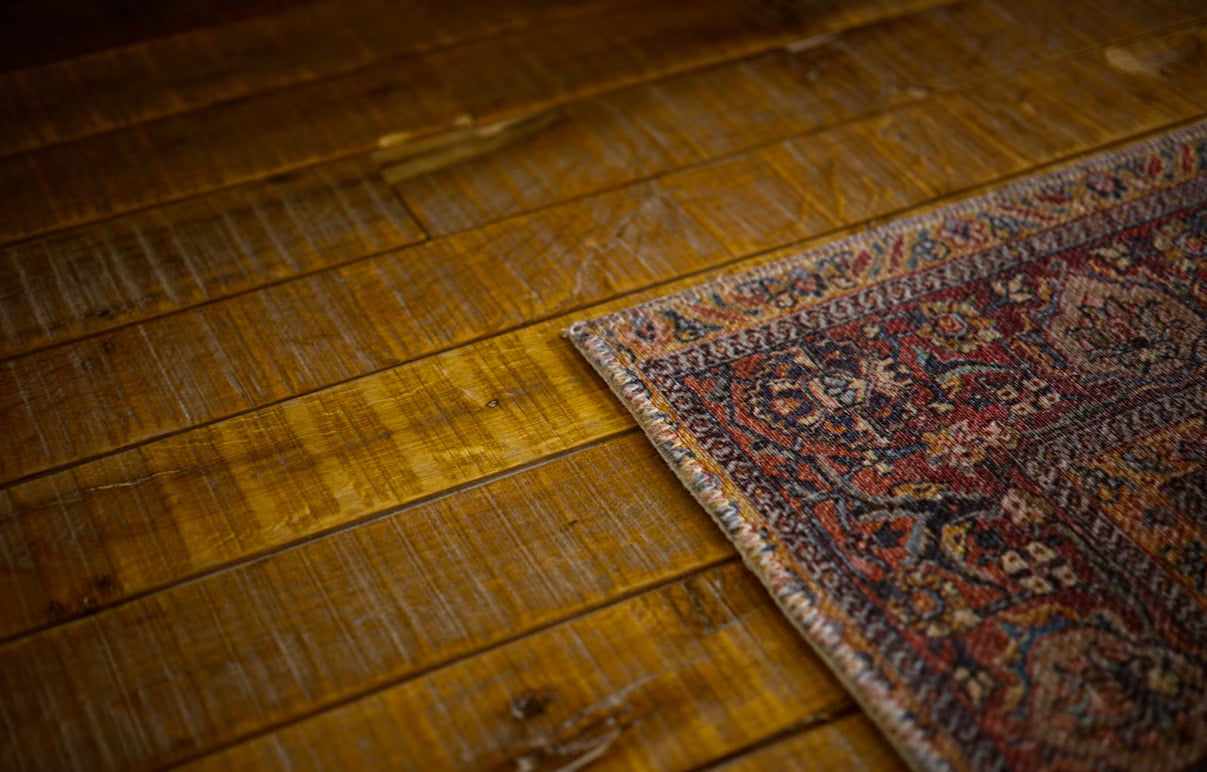
I've handled a lot of rugs. Rolled them, unrolled them, pressed my palm flat against pile to feel how it gives, held corners up to light to check how the dye sits. It's the kind of thing you stop noticing after a while — the way a chef stops tasting salt in everything except the food that's wrong.
But there was one rug, about four years ago, that reset the whole calibration.
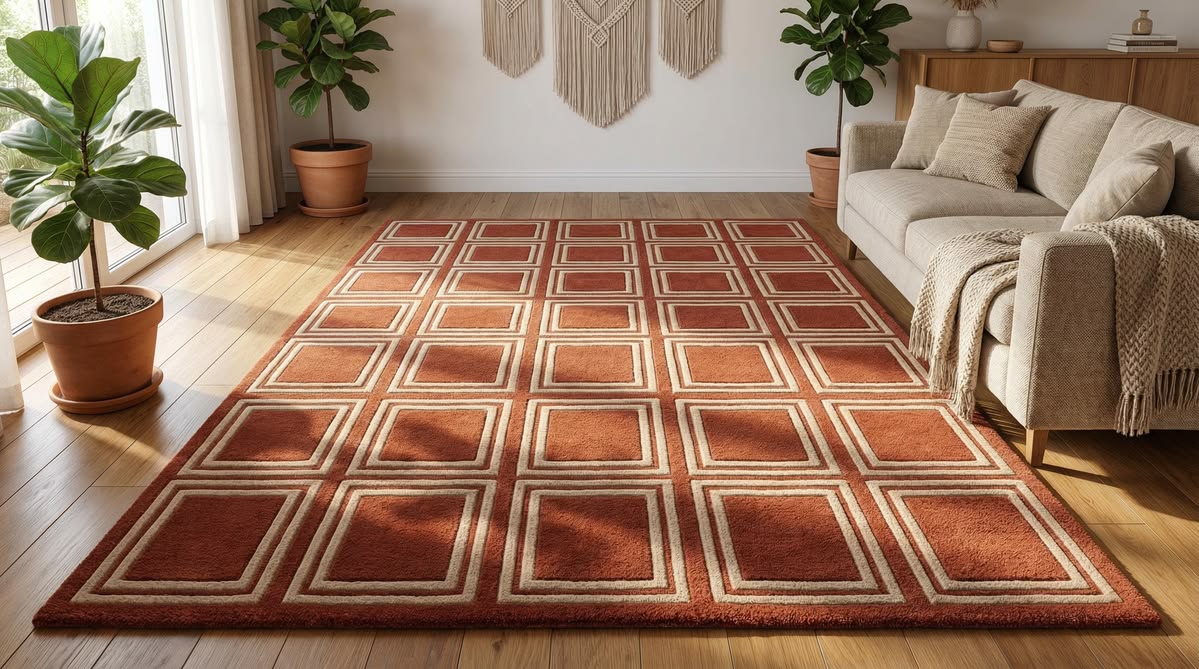
It was a hand-tufted wool piece from a workshop in Rajasthan — not one of ours, something a supplier had brought over as a reference sample. Roughly 5×8 feet, a muted terracotta ground with a geometric border that was barely a border, more of a suggestion. Nothing dramatic. The kind of rug that doesn't photograph well because its quality is entirely in the thing you can't capture: the weight of it, the way it sat on the floor like it had always been there, the pile that pushed back against your fingers with a kind of authority.
I walked on it in socks and then I walked on every other rug in the room and it was, genuinely, a little sad.
That's what I mean by ruined.

The Problem with 'Fine'
Most handmade rugs USA shoppers are searching for something that will look good in a photograph. Which is understandable — you're buying online, you can't touch the thing, the photograph is all you have. But it creates a systematic bias toward rugs that photograph beautifully and away from rugs that actually feel like something.
Most rugs sold online are fine. They're the right size, the right colour, the right price. They don't cause problems. You put them down and you stop thinking about them — which is sort of the goal, except it turns out the goal is actually the opposite. The goal is a rug you do notice. One that makes a room feel finished rather than merely furnished.
Fine rugs don't do that. They occupy space. They prevent cold floors. They coordinate.
The difference between a fine rug and a good rug is harder to explain than it should be, but here's my best attempt: a good rug has a point of view. You can feel the choices — the pile height, the dye depth, the tension in the weave. Someone made a decision about every one of those things, not an algorithm or a production line. That decision-making is what you're paying for when you buy wool rugs online, and it's what makes the difference visible — not immediately in a photo, but within weeks of living with the thing.
The thing nobody tells you: A rug made by hand will improve with age. The wool softens. The colours develop depth rather than fading flat. A mass-produced rug does the opposite — it starts at its best and declines from there.
What Actually Makes a Hand-Tufted Rug Good
I want to be specific here, because 'handmade' has become marketing language more than description. It gets applied to rugs that involved one human hand touching one machine during the production process. So let me tell you what we mean when we say it.
Our rugs are hand-tufted in India by artisans who have been doing this specific thing for years. The tufting gun — which looks like a large power drill — is guided entirely by the artisan's hands across a stretched canvas. The pattern isn't printed and traced; it's drawn, then followed by eye and muscle memory. No two passes are identical. That variation is not a defect. It's evidence.
After tufting, the pile is carved. An artisan uses scissors to sculpt the surface — defining edges between colours, adjusting pile height in different zones, creating the shadows that make a pattern read three-dimensionally from across the room. This is the step that separates a rug that looks handmade from one that just technically is.
Then it's washed. Stretched. Inspected. The backing is sealed and a scrim fabric is applied. The edges are bound, by hand, around the entire perimeter.
At every stage, a person looked at the rug and made a judgment call. That accumulation of judgment calls is why it feels different underfoot.

The Question I Get Asked Most
People ask whether a hand-tufted rug is 'worth it' compared to a machine-made one at a similar price point. I understand why they ask. The visual difference isn't always obvious in a product photo. The pile looks similar. The colours look similar. The size is the same.
Here's what I tell them:
After two years, you'll know. The machine-made rug will have flattened under foot traffic. The dye will have started to look tired. The edges may be fraying where the binding gave out. The hand-tufted wool rug, if it's a good one, will look like it belongs — a little softer, a little richer, fully settled into the room.
What this means in practical terms:
- A well-made hand-tufted wool rug lasts 15–25 years with basic care
- A typical machine-made rug at a similar price lasts 3–5 years before it looks spent
- Cost per year: a $450 handmade rug used for 20 years costs $22.50/year. A $200 machine-made rug replaced every 3 years costs $66/year
Longevity is the argument, but it's not really the argument I care about most. The argument I care about is simpler: you're going to live with this object every day. It's going to be the first thing you walk on in the morning and the last thing you see before you leave the room. You deserve to buy something that was made by someone who cared about making it.
That might sound like sentimentality. I think it's just honesty about what interior objects are for.
Why the Best Rugs Don't Always Look It Online
Here's the uncomfortable truth about buying rugs online — including from us. The qualities that make a rug genuinely excellent are almost impossible to communicate through a product photograph.
Weight. The way a good rug stays put on a floor without gripping. The springback of dense wool pile when you lift your foot. The sound a room makes when there's a good rug in it — slightly quieter, slightly warmer. None of that is in the listing.
What you can look for when you buy wool rugs online:
Pile height specification — listed in inches or cm. Low (under 0.5 in), medium (0.5–1 in), high (over 1 in). This tells you more about how the rug will feel than any description.
Material honesty — wool, jute, cotton, or blend. If the listing says 'soft fibres' or 'premium yarns' without naming the material, that's usually synthetic.
Construction method — hand-tufted, hand-knotted, flatweave, power-loomed. Each is a different thing. A hand-tufted rug is not a hand-knotted rug. Both are genuinely handmade. The distinction matters for durability and price.
Return policy — a brand confident in its product offers a real return window. We offer 30 days because we think you should be able to live with a rug before committing to it.

A Word About the Rug That Started This
I don't know where that Rajasthan sample is now. I should have bought it. I didn't, which is a decision I've made peace with, mostly.
But it changed how I talk to customers about rugs. Not with spec sheets and pile height charts — though those matter and we can have that conversation too — but with the question: what do you want to feel when you walk into this room?
Because that's what a rug does, ultimately. Not decorate. Not coordinate. It changes the register of a room. A bad rug makes a room feel like a waiting area. A good rug makes it feel like somewhere someone actually lives.
Find the good rug.
Related reading:
- What Actually Happens Inside Our India Workshop →
- Wool vs Jute vs Cotton Rugs — Which Material Is Right for Your Home? →
- The Complete Rug Size Guide →

Leave a comment
This site is protected by hCaptcha and the hCaptcha Privacy Policy and Terms of Service apply.